An Oreg spins webs. We spin a web update!

The Oreg's destiny is woven in quarantine.

If you think the world’s quarantine is dragging on, tell it to the oreg!

The oreg is a weaver bird who lives in the Holy Tongue Society’s Oger Reservoir. Many oregs perch themselves on an old lazaretto ship in the middle of the reservoir lake. They spin together webs around the ship in order to trap prisoners that the Society has quarantined — slanderous social lepers who are dangerous to the outside world!

To protect themselves from contagion, oregs wear plague doctor masks that the Society distributes. The birds are able to spin webs due to special feet that look and act like spiders. That said, the feet are neither sentient nor truly spiders.

Oregs are helpful to the Society, both as jailers and for their webs, which are good for netting and catching debris. However, people are wise to keep an arm’s distance. The birds can be very territorial over their webs.

Continue reading “An Oreg spins webs. We spin a web update!”

Beware of the Oger, the piggy bank hamster!

When most people think of fantasy worlds, ogres tend to come up. The “Milhamah” universe has its own set of beasts and monsters that inhabit it, including the oger. But an oger is a bit different from the average porcine giant…

Oger hamsters gobble up money.

Ogers are basically large piggy bank hamsters, or coin-eating “hammy” banks.  In the upcoming Milhamah Issue #3, Ogers appropriately live in the underground Oger Reservoir, a lake filled with treasures and scrap that the Holy Tongue Society has obtained in war.

Under Arigah’s authority, the oger hamsters help organize the war booty by either eating it or sticking it into their backs. When they are ready to deposit it, they spit out their contents. Piggish manners, but what can you do?

So why do ogers like to eat and store up money? Well, they are based on the shoresh root אגר, which deals with hoarding and wages. “Oger” literally means “hamster” in Hebrew, and the root also connects to “agorah,” which is 1/100 of a shekel. That is why an oger’s fur has a print that resembles the Israeli new shekel sign, similar to a dollar sign.

Ogers are typically friendly with people, and they aren’t the only creature to dwell among the Holy Tongue Society. Look forward to a bigger bestiary to come!

Arigah Egronai weaves into ‘Milhamah’

As concept work on “Milhamah” Issue #3 continues, here is another character who readers will meet: Arigah Egronai.

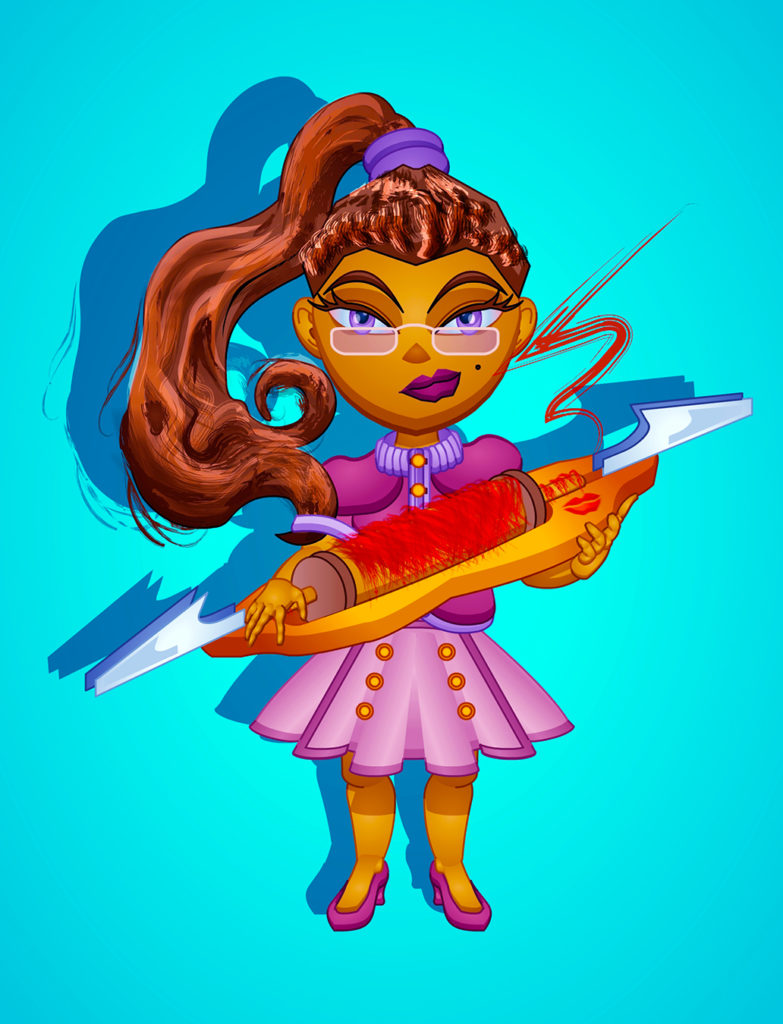
Arigah Egronai holds her weave shuttle.

Arigah is a low-level glossarist and lexicologist who works in the Holy Tongue Society’s Department of Semantics. She does most of her work in the Society’s underground Oger Reservoir, where she does intelligence research based on Bavel’s destroyed equipment and scrap.

Her main interest is reverse-engineering Bavel’s censored letters and speech balloons into armor and equipment for the Society. In order to do this, she wields a giant weaving shuttle that spins material for her creations. It makes a good double-edged spear too!

At heart, Arigah is a hoarder with a billion different plans and projects, most of them incomplete and in need of more funding. Fortunately, she hired and trained an army of Oger hamsters to do the grunt work. (You’ll meet them soon!)

Her main shoresh root is ארג, which is tied to weaving. By permuting the shoresh letters, she also has אגר characteristics of collecting, letters and wages.

How will Arigah mesh with Shem and his friends? That’s just one of the mysteries that Issue #3 will unveil…

Creator’s note

Arigah is part of the first batch of characters I have made with the latest version of Adobe Animate.  The updated brush features should make a difference in rendering hair, fur and vegetation, though it’s performance-heavy on my current computer.

Lately, I did a series of Adobe Creative Suite tutorials to catch up with newer features and techniques. So hopefully I can keep a balance between getting work done and raising the bar on quality.

I also experimented  with making Shem and Tiqwah black and white, manga-style, as a way to speed up story production. Not sure I’m satisfied with it, but I’ll keep playing with it.

On the side, I also have about 35 pages more done on the Milhamah RPG that I introduced in April. It will need revising to streamline the rules and make them both comprehensive and consistent. But I can’t wait to sell the final product — hopefully next year if the pandemic dies down by then!

Inktober Day 2: The Fire Pliers Pilferer

For the second day of Inktober, I made another generic bad guy: The Fire Pliers Pilferer!

This pilferer belongs to a group of former farmers who were born with sticky fingers instead of a green thumb. His pliers burst into flames to ward off anyone who wants to take back what he acquires.

The pilferer’s shoresh root is לקח, which carries connotations of taking, acquiring and catching fire. If you mix the letters, you get definitions for agriculture among other things.

I’m not sure when this character might appear in “Milhamah.” I can’t really see him or his fellow members being directly tied to Bavel. The macrostructure obsesses too much with its own absurd conception of order.

But maybe the pilferers could appear in a farmland world around ‘Ever, where Ḥeleq might have a safe house. Part of the fun of making new characters is expanding the possibilities for your creative world!

October greets us with a guf

Get used to seeing these bad guys in “Milhamah” Issue No. 3!

A third-rate Bavel guf is armed with a numbing needle.

This is a guf (plural: gufim). These soulless husks make up the Bavel Macrostructure’s shock troops and cannon fodder.
Giant corks replace what used to be their heads. They have the power to partially dematerialize. And they often fight with syringes that numb or weaken their opponents into blacking out.
In Hebrew, “guf” means body, but is also used for the grammar terms “first person,” “second person” and “third person.” Likewise, Bavel’s gufim come in three ranks; this one is from the third.
The guf’s shoresh (גוף) is associated with corpses, stopping things, plugs, vests, high boots, and gate valves. Mixing the letters also produces definitions of weakness, numbness, fainting and fading to black.

Inktober begins

Last weekend I started designing the first page of “Milhamah” Issue #3 after a couple of weeks of finessing the script. But in the meantime, I’ve also been thinking up characters, items and other new content to populate the “Milhamah” universe. I’ll be drawing them everyday during Inktober, so here is my first:

Inktober #1: Compassionate Vulture

Meet the Compassionate Vulture, a “caring” carrion eater who consumes the weak and dying just a bit early. But does she do it out of mercy, or hunger?

This will eventually be a generic baddie in the “Milhamah: Fighting Words” series. Its shoresh root is רחם — which encompasses compassion, wombs and vultures.

It’s a simple sketch, but I hope to do more of them in the days and weeks to come. So much of “Milhamah” is in my head, so the faster I can get the ideas down on paper, the more I can share with the rest of you!