Zimri Remez (Inktober Day 2)

Zimri Remez is the demonstrative.

Zimri Remez is my Day 2 character for “Milhamah: Fighting Words” Inktober 2020!

Zimri represents the demonstrative part of speech. As such, he is a second-string member who’s an assistant to the pronoun, Kena’an Kinnui. Zimri thrives in mystery, communicating to his closest confidants through subtle winks and gestures.

Zimri’s shoresh family is זמר. He’s a musician at heart who loves to jam on his his chief weapon, a stoplight shawm instrument that sprays fluid that stinks like rotten eggs. He also loves to sing with his pet nightingale.

All in all, he’s a bacchanal figure with mountain goat horns, and he loves to eat off the vine and sleep under the stars. But in desperate times, will Shem ‘Etzem be willing to take a hint and form an alliance?

The heroes rock the boat in Ep. 12 Part 2

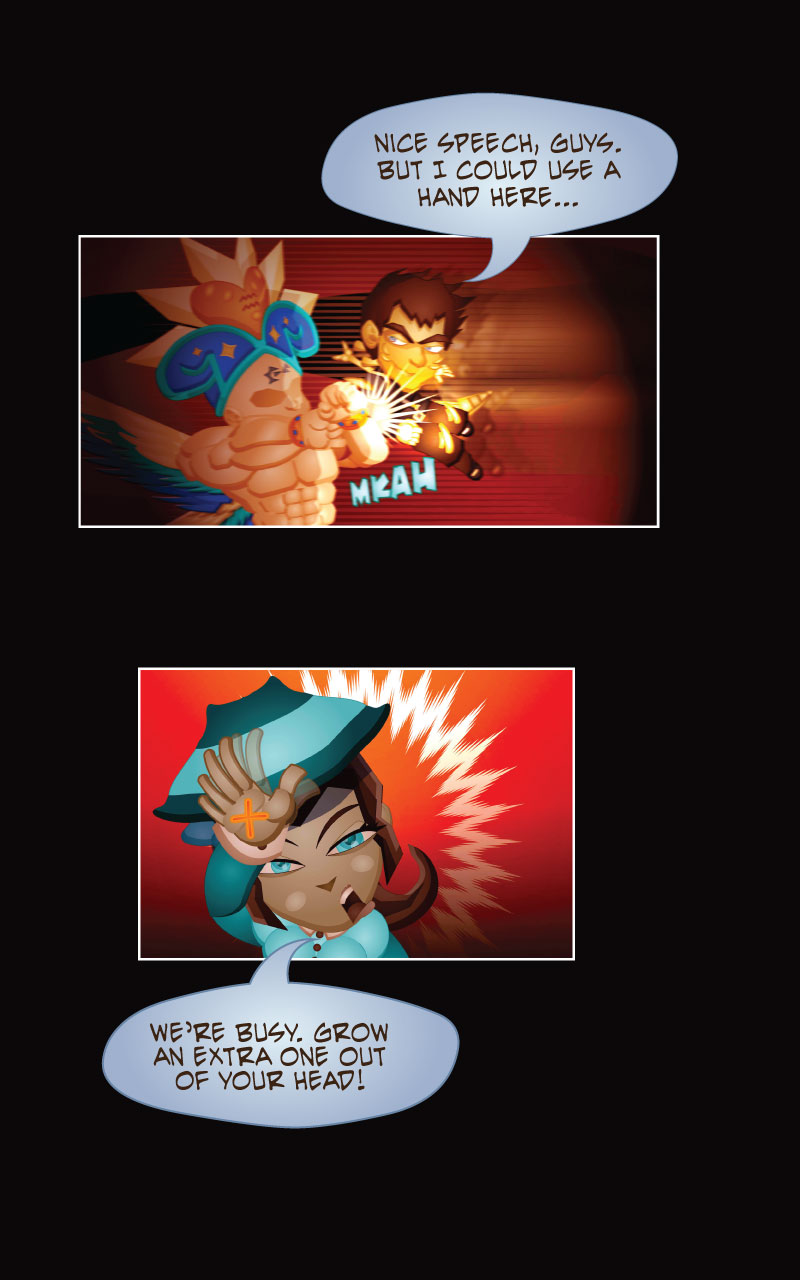
In Episode 12 (Part 2), the action picks up where we left off, with Etgar sending a speech balloon to rebuke the enemy and destroy his magic. While Shem struggles to defeat Deli’s water bearer, the Holy Tongue Society devises a new strategy to defeat evil. But has their arrogance outpaced their faith?

The Holy Tongue Society rebukes Deli. Tiqwah dismisses Shem's request for help. Tiqwah comes up with a new plan. The plan barely stays afloat.

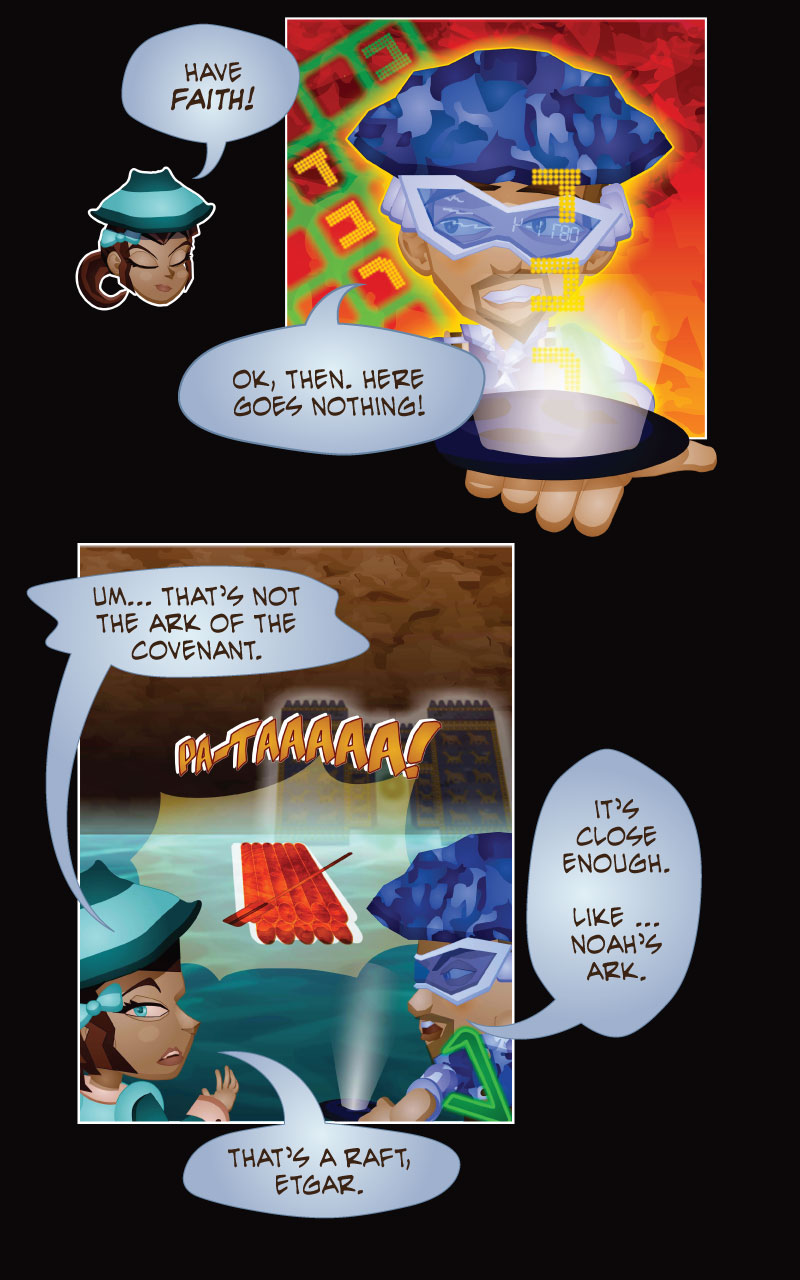
Tiqwah wants Etgar to invite the Devir — the Temple’s Holy of Holies — into the fray. In the Bible, the Holy of Holies is a room where a vessel called the Ark of the Covenant used to dwell. The high priest was the only person allowed to visit it.

The ark is a chest that held the tablets of the law, manna and Aaron’s budding rod, and man generally was neither allowed to touch it nor even look at it. According to 1 Samuel, when the Philistines captured the chest, they began experiencing plagues.

Although the ark’s whereabouts are unknown today, it’s carried a sort of mystique throughout the ages, as any Indiana Jones fan knows.

Nevertheless, Tiqwah’s strategy of carrying the ark into battle is either naive or arrogantly foolish. Fortunately, whether it’s due to divine mercy, luck or Etgar’s ineptitude, the Devir never shows up.

Instead, the Holy Tongue Society’s alfon interprets the ד-ב-ר shoresh code in a way that calls up a “dovrah” instead. Morfix defines that word as a “barge, lighter; raft.”

A raft might not be much of a weapon, but it may prove to be a lifesaver…

In other news, it feels good to be back! Behind the scenes, I’ve been drafting out the print versions of “Milhamah” in time for spring and summer conventions. I’ll certainly have enough for one issue or possibly even two. Get ready for much more information in the weeks ahead!

The urn returns in Episode 11 (Pt. 2)

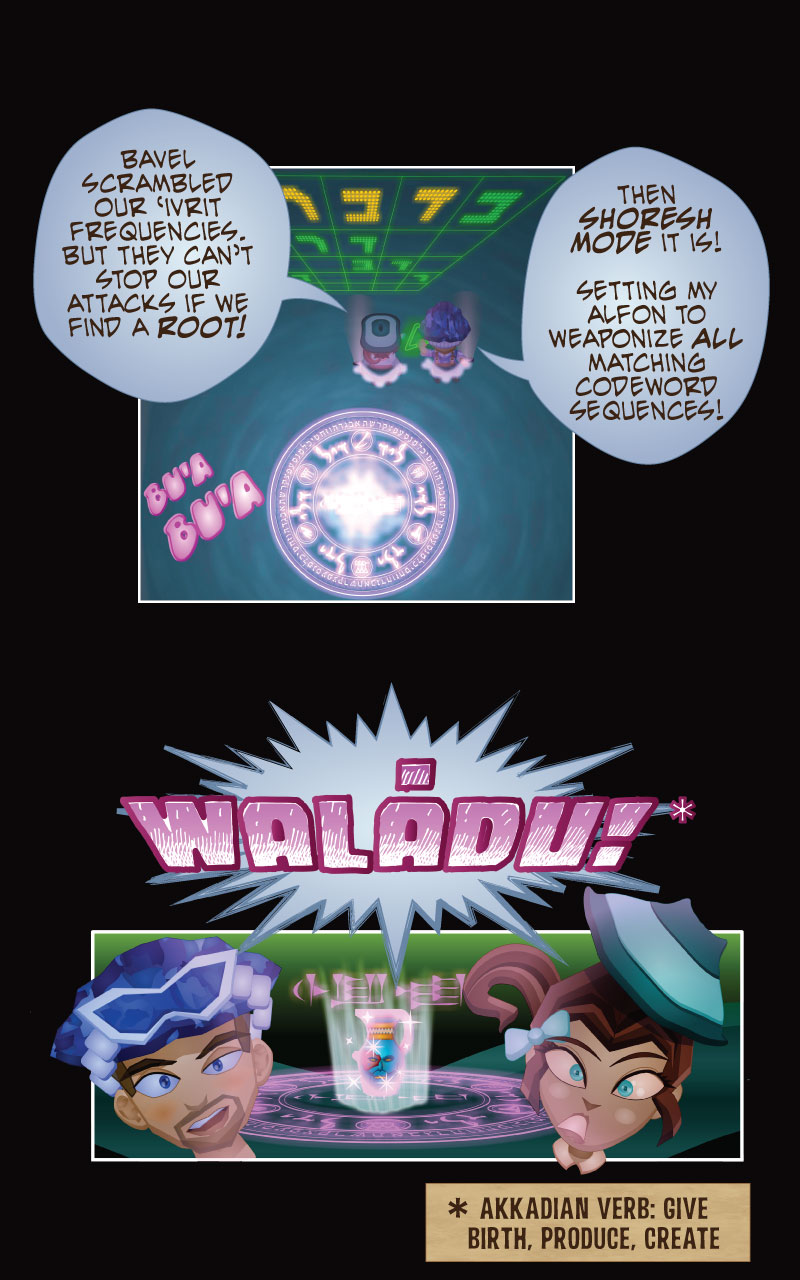
While the battle continues, the evil urn Deli startles our heroes from behind. The villain seems to be reformed … but not in a good way! Will Tiqwah and Etgar find what they’re looking for in the aural grid before it’s too late?

This is Part 2 to “Slaughter in the Water,” and you can see the earlier part here.

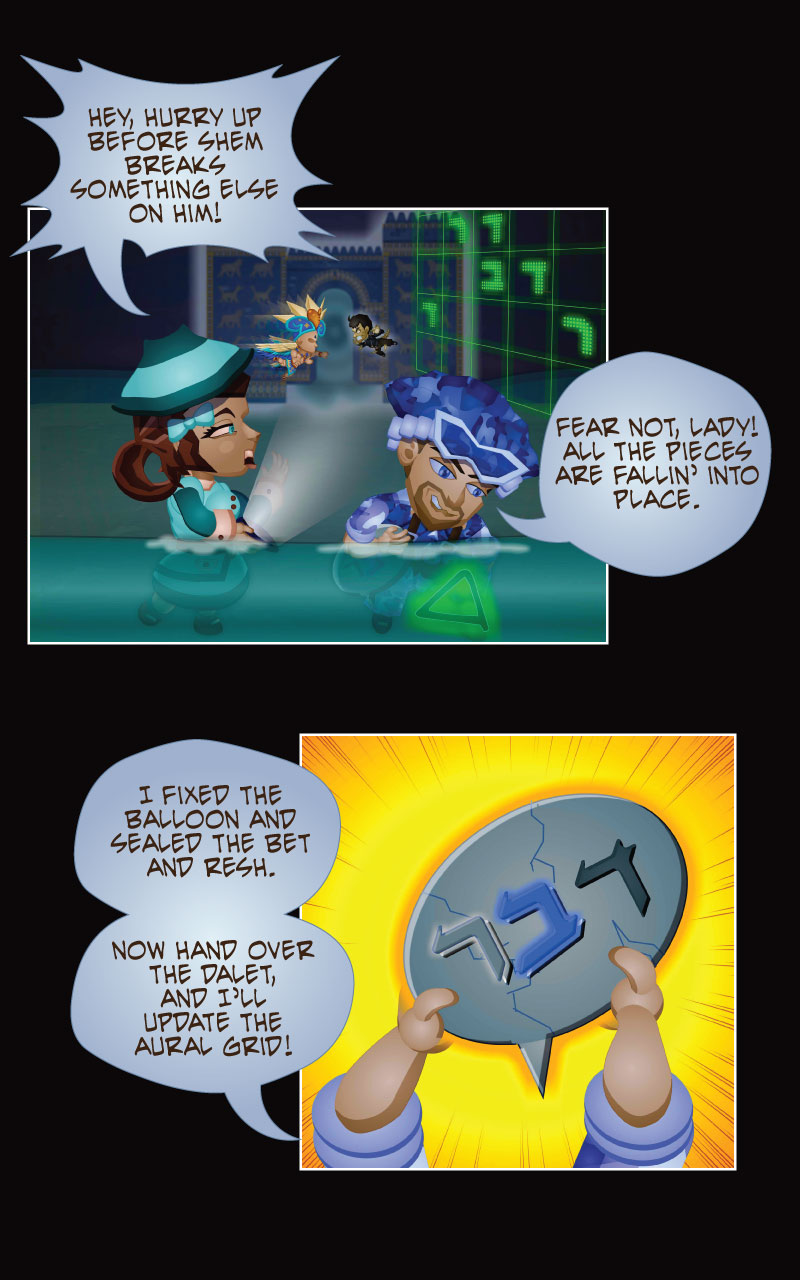
Things get technical behind the scenes in this episode, as it starts to explain how the “Milhamah” characters weaponize their alfons to make blessing attacks outside of their own natural ability. Gradually readers will learn about these things over the next few episodes, but I’ll give a preview here.

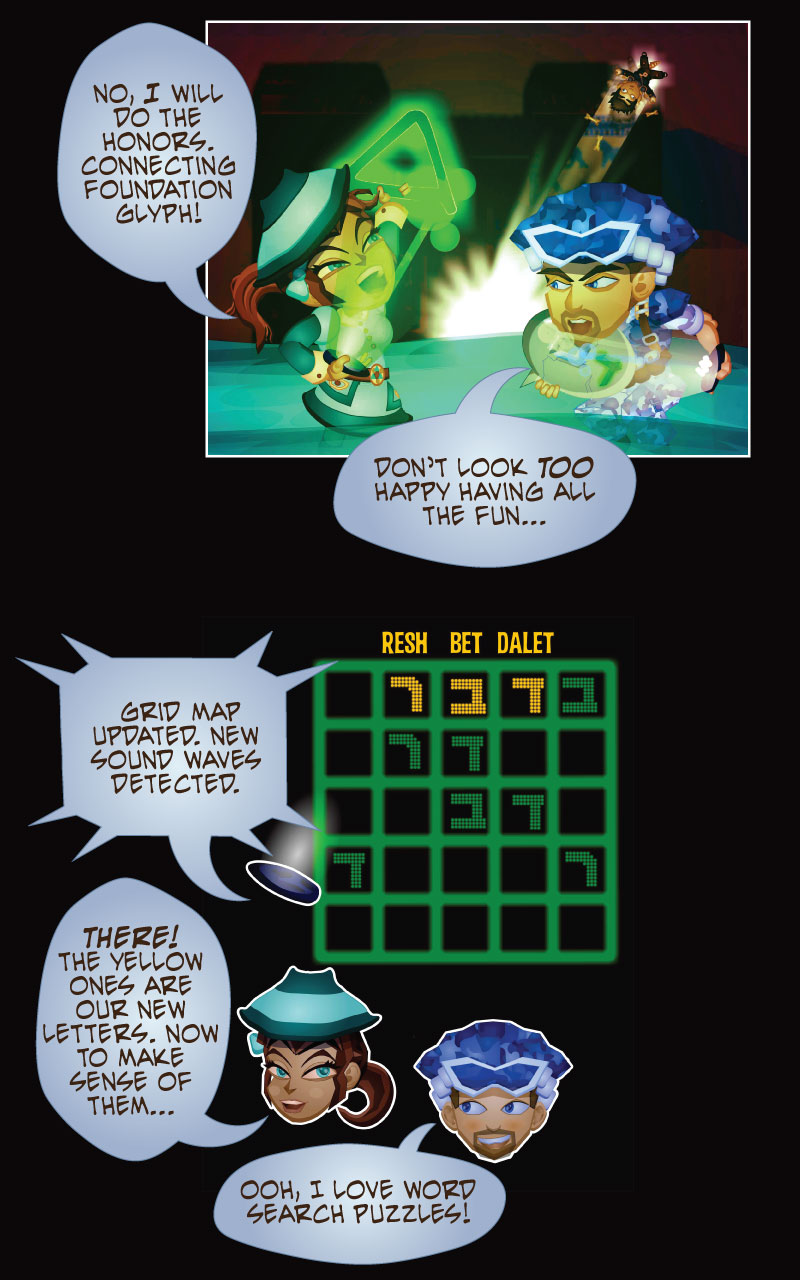
Basically, Tiqwah and Etgar connected the speech balloon and the foundation glyph to their alfons to make new letters appear in the aural grid.

The aural grid shows sound frequencies, and Tiqwah and Etgar are looking for ‘Ivrit ones to do new attacks. The evil Bavel Empire try to scramble these ‘Ivrit frequencies to make it harder for the heroes to do this. (Though in Bavel’s perspective, they believe they’re actually unscrambling their own language!)

Anyway, it’ll be up to our heroes to find the correct sequence of letters needed — a shoresh root — to code in an alfon attack, or a blessing. Will they do this next episode? Maybe…

Meanwhile, what is Deli doing?

Etgar shot the urn in Episode 9, but now the fiendish jar is back. Well, it used an Akkadian curse called walа̄du. Deli’s natural shoresh root is dalet-lamed-yod (דלי). He’s using a permuted power caused by switching the letters around, (ילד). This undergoes a consonantal shift, as in Akkadian the same Semitic root is spelled waw-lamed-dalet (ולד).

The pink seal beneath Deli contains real Semitic letters and words. The Akkadian for walа̄du in the center. The Paleo-Hebrew and Ugaritic letters for (ילד) are in the middle orbit, plus the six different root permutations in Aramaic-style Hebrew script. The outer ring has the alef-bet.

So as the comic says, Deli permuted or switched his powers around to heal himself through a rebirth. Of course, since he’s from Bavel, he does this through the power of trickery and evil. Next episode you’ll learn the difference between the Holy Tongue’s Society’s truth-guided blessings and Bavel’s manipulative curses, and why it matters.

A side note

Please take a moment to vote for Milhamah: Fighting Words” on the Top Webcomics site! The more votes we get, the more visible this comic becomes.

Also, if you haven’t signed up on our Instagram, Twitter or Facebook pages, please take a moment to do so!

Episode 10: Close Call

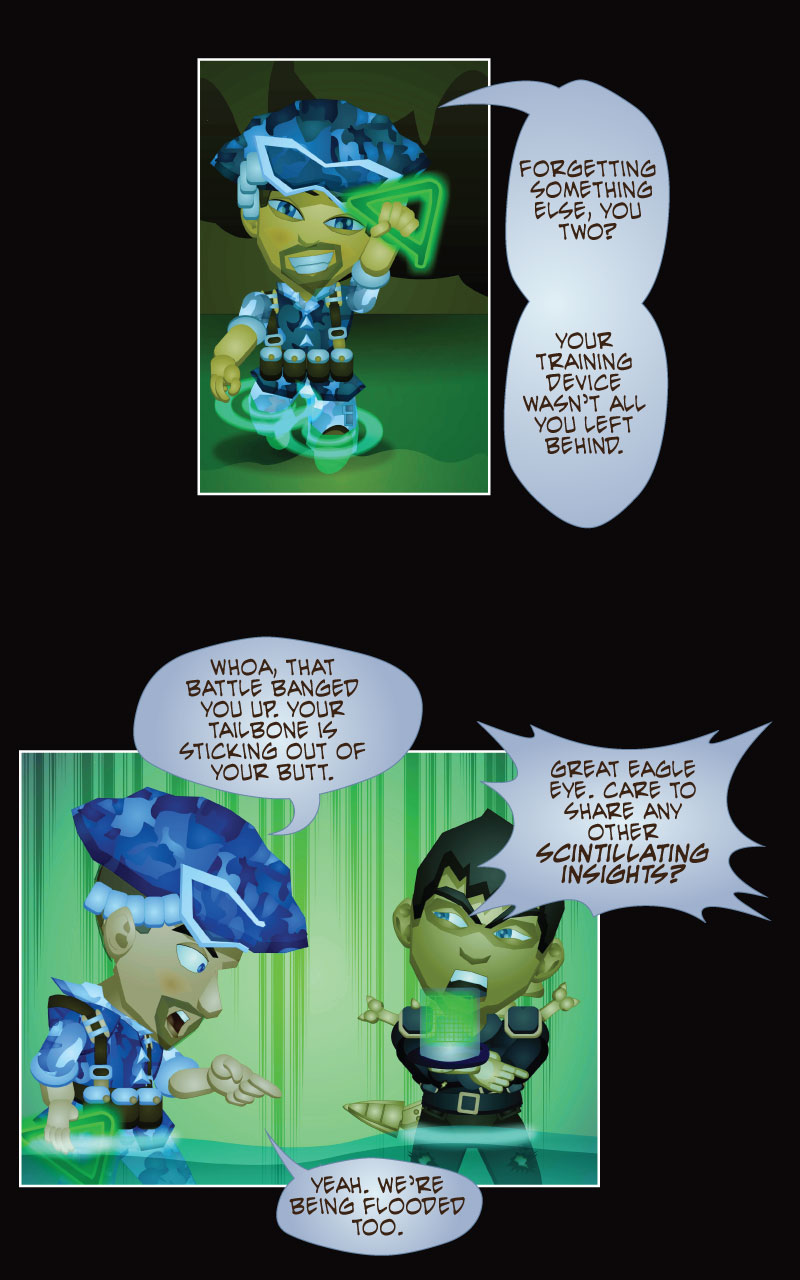
It might be a close call, but Tiqwah and Etgar manage to daze Deli and reunite with Shem. Then Tiqwah starts scolding her teammate for leaving his alfon training device behind. But will alfons be enough to stop Deli from drowning them underground?

Tiqwah and Shem reunite.


This episode is a transitional one to a pivotal action scene, which I look forward to seeing play out. But first let me give a little background on the alfon.

An alfon is a communication device and weapon that acts like a phone, radio, hologram viewer and sonic weapon. It listens to the atmosphere for conversations, even scrambled ones like Bavel uses to corrupt the communications for all other languages. Then, with the help of its user, the alfon can convert what it hears into weaponized commands.

I’ll have more news to come in the upcoming days about “Milhamah” happenings. See you then!

Welcome to Moledet

Welcome to the treacherous homeland of Moledet in this new concept design!

On the other side of Bavel’s gate is the province that Deli governs. As a coastal city battered by the tides, Moledet’s economy exports water and manpower to its surrounding provinces.

Moledet’s inspiration comes from Hebrew words derived from the shoresh root ילד, which deals with birth. (Deli uses a shoresh with the same letters swapped around.)

This location is famous for its giant midwife toads, which are actually male frogs. These creatures are in charge of raising the city’s children and brainwashing them into the armies of tomorrow. The baby in this image is swaddled in an Akkadian robe and wields a classical blade on a Bavel flag.

The Bavel Empire enjoys fanatical support from Moledet’s populace, which hates outsiders due to vague historical grievances. The citizenry also acts like a cultic family and invests much of its resources toward reproducing — naturally and artificially — for the government’s glory. It’s certainly hostile territory for the Holy Tongue Society!

In the new year, look forward to seeing more of Moledet in future episodes of “Milhamah: Fighting Words.” The next webcomic, Episode 10, should be ready by next week.

Later this week I’ll also publicize the new “Milhamah” RedBubble online store. While it was too late to make anything specific to Hanukkah, there is enough merchandise over there to make a great Christmas or holiday gift. And I’ll add new designs throughout 2019!